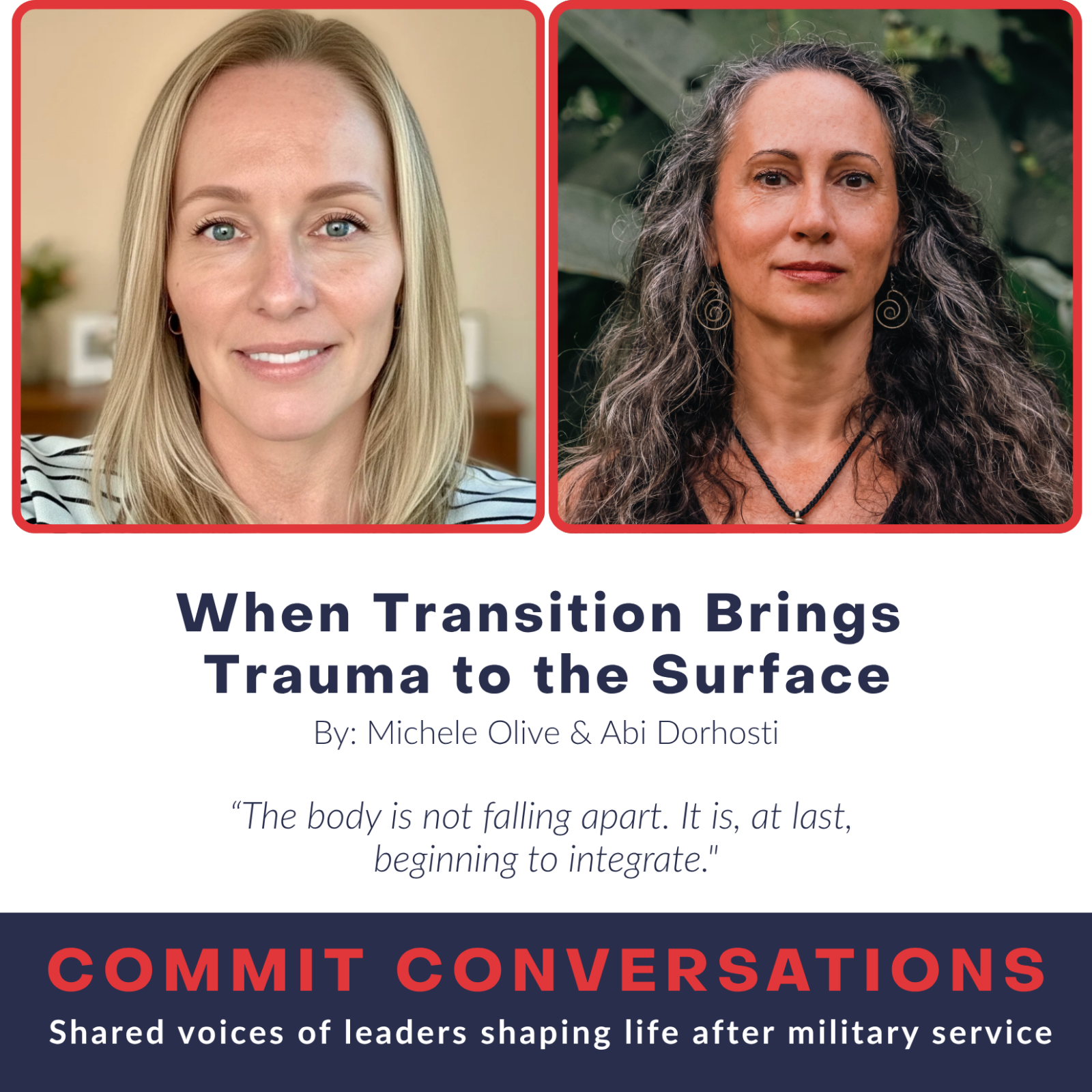
Two Perspectives, One Pattern.
When Michele joined The COMMIT Foundation in 2017, she didn’t expect to use her clinical background in the way she eventually would. Co-founder Anne Meree Craig brought her on for her skillset, but not for clinical treatment—a distinction that seemed puzzling at the time. Yet, after thousands of conversations with veterans preparing for civilian life, Michele began to see a pattern: as the transition date approached, stories of trauma often surfaced in ways they hadn’t earlier in these members’ careers.
Abi first met Michele at a COMMIT Foundation retreat in 2019, when Abi herself was preparing to transition out of the military. Like many service members approaching that moment, she was beginning to ask deeper questions about what would come next. During her years in uniform, Abi had often been entrusted with the private stories of fellow service members carrying trauma, moral pain, and difficult experiences. Those conversations stayed with her.
With an undergraduate background in behavioral science, Abi found herself increasingly drawn toward the mental health and healing spaces as she planned her next chapter. While transitioning out of the Air Force in 2022, she initially pursued a coaching certification, hoping to better support the kinds of conversations she had witnessed throughout her career. That path continued to deepen, and in 2024 she began a PhD in Transpersonal Psychology. Her research now focuses on pathways to healing moral injury and moral distress, inspired in part by her own experiences and by the stories of so many of her peers.
Several years after that first retreat, Michele came across Abi’s writing on moral injury and reached out about collaborating on a blog post for the COMMIT community. As we began talking, we realized we had both been observing a similar pattern among many transitioning service members.
There are many service members who look exceptional on paper while quietly struggling on the inside. High standards, discipline, and a deep sense of responsibility can make it difficult to admit when something isn’t right. Recognizing that these reactions are common, that support exists, and that difficult experiences can eventually be transformed into hard-earned wisdom can be an important first step. This article grew out of that conversation.
Transition is Not Just a Career Change
A service member’s value, purpose, and daily rhythm are dictated by the mission and the uniform. When we talk about “transition,” the conversation usually centers on translating military skills to a corporate resume. But you don’t just leave a job; you leave a culture, a support system, and a defined version of yourself.
In the military, your “Why” is given to you. In the civilian world, you have to invent your own “Why.” This shift from collective purpose to individual agency can feel like standing in a void, which is often when old echoes of trauma begin to fill the silence.
Defining success can also be a challenge. While in service, success is often linear and visible: a promotion, a successful deployment, a commendation. Through transition, we have to widen the aperture of what “winning” looks like. It really is more of a transformation. True success in this transformation isn’t just about finding a new paycheck; it’s about finding a sustainable way to carry your history into your future without it weighing you down.
Are Your Coping Skills Helping?
In high-threat environments, the body operates in a state of chronic sympathetic nervous system activation (fight or flight). Constant high levels of adrenaline and cortisol act as a biological “numbing agent.” The brain prioritizes immediate survival and mission completion over emotional processing.
Service members are also often trained to compartmentalize and box up emotions to remain functional. While the uniform is on, the brain views this suppression as a survival requirement. When the mission ends, the brain often finally feels safe enough to let these suppressed memories and emotions surface.
Distraction can also be a powerful coping mechanism. When every hour of the day is accounted for, there is no “white space” for intrusive thoughts or traumatic memories to enter. Upon taking off the uniform, there can be a loss of routine that creates a vacuum. In the relative quiet of civilian life, if the brain no longer has a mission to focus on, it turns inward to process the backlogged trauma of the past years.
The “Tribe” and Social Buffering
Human beings are wired for connection, and the military/first responder community provides an intense version of this known as unit cohesion.
When you are surrounded by people who have seen what you’ve seen, you have a shared reality and the trauma feels normalized. You don’t have to explain your reactions because everyone around you is reacting the same way. This mirrors how we often see physical symptoms normalized—for instance, ‘Doesn’t everyone have daily headaches?’
In the civilian world, a general sense of connection and community changes. The realization that your experiences may not be normal to the general public can lead to a sense of alienation, which often triggers latent symptoms of hypervigilance.
The Armor and the Self
The uniform isn’t just clothing. For many service members, it functions as a psychological container, a second skin that provides a clear script for how to act, how to lead, and how to survive. It confers hierarchy, identity, purpose, and belonging in a single gesture of putting it on each morning.
When that armor comes off, the self underneath can feel unexpectedly exposed. The structure that once held everything in place is gone, and what remains is a person who has been defined by service for years, sometimes decades, now standing outside the frame that made sense of them. Many veterans describe this as a kind of invisible wound that can be quietly destabilizing. They go from being a highly skilled professional with a clear role and recognized value to a civilian world that often has no language for what they have carried.
The Life Review and Moral Injury
Something else often begins in this unstructured space. With the mission removed and the pace of daily life slowed, many veterans find themselves in what might be called a life review: a natural, sometimes involuntary process of revisiting memories, decisions, and experiences from their time in service.
During active duty, actions are understood within the context of the mission. That context provides a kind of moral shelter. Once a person steps outside it, the same memories can look different. Events that were once framed as necessary, or simply filed away without examination, begin to surface and be re-evaluated through a more spacious lens. This can give rise to late-emerging feelings of guilt, grief, or moral conflict, which researchers increasingly distinguish as moral distress. When these feelings are left unacknowledged or unsupported, moral distress can deepen into something more entrenched: moral injury, a wound not to the body or even to the psyche in the traditional sense, but to the soul’s understanding of what it has witnessed or done. Moral injury arises when we act, or fail to act, in a way that violates our moral compass, or when betrayal shatters our trust in the people or systems we believed were right and just.
Moral distress or injury is not a sign of weakness or breakdown. In many ways, this is the conscience doing what it was always meant to do. If this burden feels heavy, professional support is a powerful tool to help you find a path forward.
What Can We Do When the Past Finally Surfaces?
Understanding why these experiences surface after transition is important. But an equally important question follows: what do we do when they do?
When difficult memories or emotions begin making themselves known, it can feel alarming. Many veterans assume something has gone wrong. In reality, the opposite may be true. The surfacing of long-suppressed experiences is often a sign that the nervous system finally senses enough safety to begin processing what was previously pushed aside in the service of the mission. For years, the mind and body have protected the individual by prioritizing survival, performance, and function. When that operational environment fades, space opens for what was never fully processed.
Symptoms can be uncomfortable, but they can also signal readiness. The body is not falling apart. It is, at last, beginning to integrate.
Post-Traumatic Growth: Making Meaning from Pain
This is where the concept of post-traumatic growth becomes important. Growth does not necessarily mean the suffering was justified or that the pain disappears. Instead, growth comes through the difficult, often non-linear work of meaning-making. Experiences that once felt overwhelming or morally destabilizing can gradually be understood, integrated, and woven into a broader sense of identity and purpose.
In the context of moral injury, the pain itself can carry important information. Feelings of guilt, grief, or moral conflict often reflect something deeply human: the presence of conscience. When supported appropriately, that moral pain can become a foundation for wisdom, connection, and a renewed commitment to living in alignment with one’s values.
Over time, many veterans describe a profound shift. Identity begins to rebuild from the inside out, no longer dependent on a role or uniform. There is often greater empathy, a deeper capacity to sit with others in their hardest moments, and a clearer sense of what truly matters. Leadership forged through this kind of integration tends to be quieter, but also deeper and more resilient: the kind that can only come from having gone through something and found a way to carry it with meaning.
We Heal in Community
That kind of integration rarely happens alone.
Transition support that focuses only on career placement misses something essential. The emotional and identity shifts that follow leaving the uniform behind are real, significant, and worth preparing for. Asking for support is not a departure from strength; it is an expression of the same commitment to mission readiness that defined years of service, only now the mission is a sustainable life. Delayed responses to trauma are normal. Long-term community matters. Safe spaces where stories can be told without judgment can make a profound difference.
Being witnessed by others who understand the experience, who do not need the story explained or the reaction justified, can interrupt the isolation that so often follows transition. Relational compassion helps soften the shame that tends to harden around unprocessed pain, while self-compassion allows a person to face their own history without collapsing into self-condemnation. Neither comes easily. Both matter and become more likely in the presence of genuine community.
Community does not have to begin with sharing your deepest experiences. For many, it starts with something simple and tangible: movement, shared effort, or common interest. Running groups, climbing gyms, jiu-jitsu academies, yoga classes, or outdoor meetups can provide structured ways to reconnect without the pressure to explain your story. Veteran organizations, peer groups, and service-based communities can offer a different kind of connection, one rooted in shared understanding. Over time, these spaces often become more than activities. They become places where trust builds naturally, where conversation opens when it is ready, and where a sense of belonging begins to take shape again.
Seeking professional support can be a meaningful part of this process. Not all support is the same, and it is worth finding someone who understands trauma and, ideally, the unique context of military or first responder experiences. This might include trauma-informed therapists, clinicians trained in approaches such as EMDR or somatic therapies, or practitioners who integrate mind, body, and relational healing. Approaches that engage the body and nervous system directly, rather than relying solely on verbal processing, can be especially important when shame and self-condemnation are at the center. For some, group-based programs or veteran-specific communities can offer an additional layer of understanding and connection. Reaching out for support is not about fixing something that is broken; it is about having the right kind of guidance as you learn to work with experiences that were never meant to be carried alone.
The goal of healing is not a return to who someone was before. For many veterans, the deeper work of integration leads somewhere new: a life shaped not only by service, but by the wisdom gained in the long process of learning to understand it.
Conclusion
If you are moving through transition and find that old experiences are beginning to surface, know that this is not a malfunction. It is not a weakness, and it is not evidence that something has gone permanently wrong. It may, in fact, be the first signal that your nervous system finally feels safe enough to do the work that the mission never allowed.
The path forward is not about leaving your service behind. It is about learning to carry it differently, with understanding, with support, and over time, with something that begins to feel like wisdom. That path is rarely straight, and it is rarely traveled alone. But it is real, and it is possible, and for many veterans who have done this work, it has led somewhere more expansive than they expected.
You gave years to the mission. What comes next is worth that same level of commitment.
About the Authors
Michele is a licensed clinical social worker and transition specialist who has spent years in conversation with service members navigating the passage out of uniform. Her work with The COMMIT Foundation sits at the intersection of clinical insight and genuine human presence.
Abi is a retired Air Force officer, wellness practitioner and coach, and PhD candidate in Transpersonal Psychology at Sofia University. She developed and is an adjunct professor for Sofia University’s new Veteran Leadership concentration within their MA and PhD in Transpersonal Psychology. Her research focuses on pathways to healing moral injury and moral distress in veteran populations. She brings both professional expertise and lived experience to this work, having navigated her own transition and the terrain this article describes.